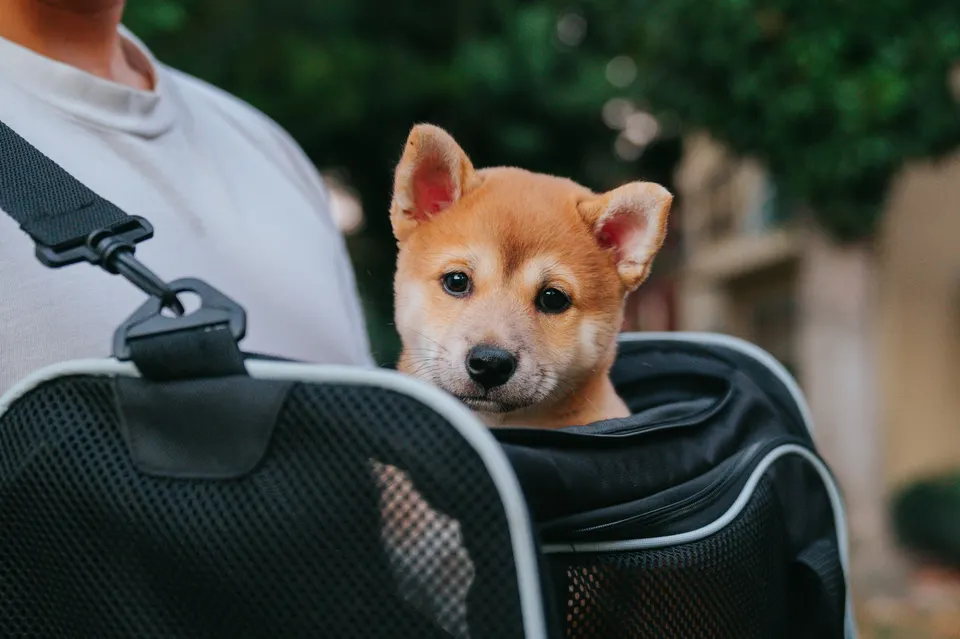
Flying with pets from Singapore starts with your dog or cat, not an airline booking. The right plan depends on their health and size, the route and what happens after you land. A flight that accepts animals is only one part of the journey. For a holiday, you also need a workable route home.
Cover photo: Dex Ezekiel on Unsplash. Illustrative travel photo; this does not show an approved airline carrier or a verified international journey.
TL;DR
- Check destination entry, the operating airline and Singapore re-entry before paying for flights.
- Your options are commercial cabin travel, checked baggage, manifest cargo, a shared charter or a private charter. They are different services, not interchangeable ticket upgrades.
- Start with your pet's records. Vaccines, blood sampling and waiting periods can determine the earliest practical travel date.
- DIY preparation can work, but returning through Changi requires an AVS-recognised pet agent for import clearance.
- A blood test, a private flight or a short stay does not automatically remove quarantine requirements.
This guide covers existing pet dogs and cats travelling from Singapore for holidays or relocation. Rules and policies were checked on 18 September 2026; confirm your specific itinerary before committing.
Flying with your pet from Singapore: check both journeys
For a holiday, write down the intended departure and return dates first. Then ask four questions: can your pet enter the destination, can an airline carry them, can they return on your chosen date, and is the whole trip suitable for them?
For a permanent move, your immediate priority is admission and settling in. Still keep complete records: a future move back to Singapore will need its own assessment.
Build a short pet profile before making enquiries: species, breed or crossbreed, age, microchip number, current weight, crate dimensions, vaccination dates, medical needs, ownership history and countries visited. Send the same profile to each provider.
Think beyond the flight. Where will your cat have a secure room? Can your dog use local transport? Who will help if a return certificate is delayed? For a short break, reliable care in Singapore may fit your pet better than two international journeys. That is a reasonable choice, not a failure to include them.
Do not book around a generic preparation estimate. A healthy adult with usable records and a pet starting a vaccination sequence can have very different calendars.
Choose between cabin, checked baggage, cargo and charter
Commercial cabin travel
On accepting airlines, a small dog or cat travels in a carrier within the passenger cabin, usually under the seat. Weight is not the only test: the animal must fit comfortably in the permitted space.
For example, Lufthansa's policy allows qualifying dogs and cats weighing no more than 8 kg with their container, subject to its conditions. That does not confirm every Singapore itinerary or connecting flight.
Cabin travel can keep you closer to your pet, but it is not permission for them to occupy a spare passenger seat or wander around. Ask about carrier measurements, cabin class, pet allocation and every operating carrier before booking.
Checked baggage
Your pet is booked to accompany you on the same passenger flight but travels in the aircraft hold in an accepted crate. You do not have access to them during the flight.
The phrase sounds impersonal, and feeling uneasy about separation is understandable. Ask practical questions about the handover, holding area, loading, water provision and what happens during a delay. A reassuring label is less useful than a clear handling plan.
Manifest cargo
Here the pet travels under an air waybill through a cargo booking and handling process, rather than your passenger baggage allowance. You may travel separately, and cargo acceptance and collection arrangements need their own coordination.
An airline or destination may require this method, or the pet and crate may exceed passenger-service limits. Ask what aircraft, routing, handover point and collection arrangements are proposed.
Also ask which government entry category applies. The air waybill is a transport document, not proof that the pet has met the destination's entry requirements.
Shared charter
A shared charter sells places or packages on a chartered aircraft alongside other travellers and pets. The Asian Pawrent's SingaPaw Air service advertises jet sharing as well as whole-aircraft arrangements.
Ask whether the departure is confirmed, what the package buys, who actually operates the aircraft and what happens if the group does not fill. Check separation between animals, restraint rules and any fuel stops. Do not assume a promotional date equals an available, approved booking for your pet.
Private charter
You arrange the whole aircraft rather than a place on a shared trip. The operator, aircraft and authorities still have to accept the journey. More control over scheduling does not remove health rules or make every pet fit to fly.
For provider options and the questions to put beside a quotation, read our guide to private pet flights from Singapore. Compare the complete journey, including clearance and ground transport, rather than the cabin alone.
Check the operating airline, not just the ticket
Singapore Airlines
Singapore Airlines' ordinary-pet policy provides checked-baggage carriage for eligible dogs and cats, not ordinary pets in the cabin. If pet and container together exceed 32 kg, it directs owners to a cargo agent.
It excludes Boeing 737-operated flights, applies aircraft-specific crate-height limits and restricts certain destinations and flight directions. Being under 32 kg is therefore not enough to establish acceptance. Its checked-baggage exclusions include breeds such as French Bulldogs, Chow Chows, British Shorthairs and Scottish Folds. Ask the airline to assess your exact breed or crossbreed.
SIA asks for contact at least two weeks before departure. That is a booking lead time, not enough time to complete every country's medical preparation.
Its trained assistance-dog policy is separate. Emotional-support, comfort and companionship dogs are not treated as trained assistance dogs.
Scoot and other carriers
Scoot does not accept ordinary pets. Its stated service-dog exception must not be mistaken for a small-pet cabin allowance.
For any airline, request written confirmation covering the exact flight numbers, breed, total weight, carrier and travel class. A codeshare ticket can involve another operator with different rules. Recheck both directions, transit arrangements and any aircraft change.
Keep the pet confirmation beside your own booking. If a flight changes, ask what changes for the pet too; do not assume the original acceptance follows automatically.
Decide what to do yourself and what to delegate
Who handles each part?
You supply accurate history, choose the itinerary, obtain the necessary approvals and keep track of deadlines. Paying an agent does not make incomplete records usable.
Your vet assesses fitness, checks identification and carries out the required vaccinations, sampling, treatments and examinations. Bring the official destination and return requirements, not just a screenshot of another owner's experience.
Government authorities determine entry conditions and issue or endorse official documents. A private vet's signature and government endorsement may be separate requirements.
The airline and its handlers decide carriage acceptance and manage the airport handover. A pet agent may coordinate these services but is not necessarily the aircraft operator.
A relocation or clearance agent can manage selected tasks or a wider package. Ask which jobs they perform themselves, which are subcontracted and who remains contactable when flights change.
Where DIY stops
You can organise records, vet appointments and some applications yourself, subject to the route's requirements. However, since 1 April 2026, CAPQ import clearance at Changi requires an AVS-recognised pet agent, including for accompanied pets.
This does not mean you must buy a door-to-door package for both legs. Ask for clearance-only and fuller-service quotes, with responsibilities itemised. For arrivals at another Singapore port, obtain the specific AVS instructions.
Our Singapore pet relocation agents guide helps you compare that scope. A useful question is: "Which decisions and deadlines will I still own after paying you?"
Pick a destination that works for your actual trip
Start with country admission, then test the holiday you would actually take. A dog-friendly hotel does not establish airline acceptance, and an easy arrival does not establish an easy return.
Consider journey length, connections, pet-friendly transport, accommodation restrictions and access to a vet who can prepare export documents. For cats, a stable base may be more practical than a busy multi-city itinerary.
Our quarantine-free pet travel comparison puts destination entry alongside Singapore-return conditions. Read "quarantine-free" as conditional eligibility, not a promise that no checks or preparation are needed.
France: entry and return are different
French Customs lists Singapore among origins exempt from the rabies antibody test for qualifying pet entry. Identification, valid rabies vaccination, official documents and entry checks remain necessary. Under EU guidance, a primary rabies vaccination normally needs at least 21 days to become valid.
That outward exemption does not remove Singapore's return bloodwork. Use the Singapore-to-France pet travel guide for the complete sequence, including arranging the French vet and endorsement before coming home.
Japan: prepare well before the holiday
Singapore is outside Japan's designated-region list. The standard non-designated process includes a microchip, two qualifying rabies vaccinations, an approved antibody test and 180 days from blood sampling before arrival, plus notification at least 40 days ahead.
That is preparation time, not six months every compliant pet must spend in a Japanese quarantine facility. Our Singapore-to-Japan guide explains the sequence, validity windows and return planning.
Plan the Singapore return before leaving
Start with the correct schedule
AVS's import categories apply to entry into Singapore. They do not tell you what another country requires on arrival.
- Schedule I: Australia, New Zealand, Ireland and the UK. Fully compliant pets can enter Singapore without quarantine.
- Schedule II: includes France and Japan. Quarantine exemption depends on compliance, personal-import circumstances and owner/pet history.
- Schedule III: countries outside I and II. The ordinary conditions require at least 30 days at the Animal Quarantine Centre.
Do not choose the schedule solely from the final airport. Earlier residence, travel and transit can affect the assessment.
A short holiday is not automatically a six-month stay abroad
The Schedule II certificate has an origin option for pets continuously resident in qualifying Schedule I/II countries since being imported directly from Singapore. It is an alternative to the usual six-month residence route, not a waiver of the other conditions.
The Schedule I certificate also has a direct-from-Singapore option, but its continuing-residence countries are Schedule I only.
So a holiday need not become a compulsory 180-day overseas stay. Have AVS assess your full itinerary and evidence rather than assuming that a short trip either guarantees quarantine or exempts you from everything.
Ownership and travelling together matter too
AVS's current Schedule II overview describes no-quarantine personal imports where the pet arrives less than five days from the owner's entry and has continuously shared the owner's residential address for more than six months. Otherwise, it describes a minimum ten-day home-quarantine requirement for personal imports.
The formal conditions also address ownership transfer and pets recently obtained overseas. Exactly-five-day, exactly-six-month or unusual ownership/address cases need AVS confirmation; do not build a non-refundable booking around an assumed exemption.
The blood-test clock is separate
For Schedule II return, the sample must be taken at least 28 days after the primary rabies vaccination or last booster, with a qualifying result of at least 0.5 IU/ml. Sampling must fall 90 days to 12 months before export back to Singapore, using an accepted laboratory.
This is why a France holiday may need bloodwork months before departure even when France does not require it. Ask your vet to map both countries' vaccine and test rules before adding boosters or reusing an old report.
Our Singapore pet import guide covers the inbound workflow. Treat this section as an early feasibility check, not your final clearance checklist.
Build one paperwork calendar for both directions
Keep permissions separate
An AVS export licence is required for taking a dog or cat out of Singapore, including on holiday. It is valid for 90 days.
The destination decides whether you need its permit, a specific health-certificate template, government endorsement or a pre-export inspection. These are not interchangeable documents. Do not assume every departure needs an examination at CAPQ, or that a private health certificate is automatically sufficient.
For the return, arrange the overseas vet and any official endorsement before the trip begins. Share the actual AVS certificate template and ask who signs each section. A short holiday can still need appointments abroad; do not leave that job for the final afternoon.
Make the record pack easy to audit
Keep a folder with identification, vaccination records, laboratory reports, permits, airline confirmations and the full itinerary. Check the microchip number character by character across documents. Keep originals where required and accessible backup copies.
The order matters as much as the paperwork. For EU entry, the rabies vaccination must not predate the microchip identification or reading. Ask the vet to review the recorded sequence rather than simply confirming that a vaccine is current.
Give every task an owner, deadline and prerequisite. "Health certificate" is not a complete calendar entry; "vet completes destination template, then official authority endorses it within the required window" is.
For France, the EU entry certificate window is ten days from official issue to entry checks. Other documents can have different windows. A certificate that was correct for last year's trip is not a substitute for this itinerary's paperwork.
How early should you start?
Work backwards from the slower of the outward and return requirements. Begin with a records review, not a fixed promise such as "all pet travel takes a month".
If Japan requires a new qualifying antibody test, the 180-day wait begins at blood sampling, after the necessary vaccination steps. Starting six months before departure may already be too late.
For a fresh Schedule II return sequence, the vaccine-to-sample and sample-to-export intervals described above must both fit. Count back from the flight leaving the overseas country for Singapore, not from the date you initially leave Singapore. Existing compliant records may change what needs repeating; only a records review can establish that.
Put long-lead tests and notifications first, then flight acceptance, followed by the tightly timed certificates and treatments near departure. Allow room for laboratory turnaround, unsuitable results, appointment availability, weekends and official processing.
Write down what expires if the flight moves. A delay can affect a health certificate while leaving another document valid. Ask the vet, agent and airline which parts need updating rather than restarting or reusing the entire pack blindly.
Budget for flying with your pet from Singapore
The useful comparison is a written, route-specific total, not a generic price for "flying a dog".
Separate these items when requesting quotes:
- Flight carriage or charter package, with pet count and crate dimensions.
- Veterinary appointments, vaccines, tests, laboratory handling and document preparation.
- Government licences, certification and destination permits where required.
- Carrier or crate, airport transfers and any storage.
- Agent services, terminal handling and arrival clearance.
- Quarantine or approved home-quarantine costs where applicable.
- Rebooking, replacement documents and extra accommodation if plans change.
AVS lists a personal export licence at S$50 for normal service or S$100 express. Its import licence has the same stated normal/express fees. These are licence charges, not the full paperwork bill. Fees checked on 18 September 2026.
Ask for the currency, tax treatment, inclusions, exclusions and cancellation terms. Do not compare a one-way flight-only figure with a return package that includes handling.
For a holiday return, Singapore Customs also has a conditional GST-relief process for residents returning with their own pets after overseas travel. Its application should be submitted at least five working days before arrival. Relief is not automatic, and relocation has a separate process.
Prepare the carrier and your pet
Buy for the animal and the aircraft
IATA's container requirements require space for natural standing, sitting, turning and lying down. Account for bedding, ventilation, secure construction and the relevant feeding/water arrangements. The airline can impose additional limits.
"IATA approved" on a shop listing is not an airline acceptance certificate: IATA does not certify commercial pet containers. Send the actual model, measurements and pet details to the carrier before buying an expensive crate.
A soft bag accepted in a cabin will not do every job. Ordinary pets returning through Changi need a rigid crate for transfer to CAPQ. Arrange where that crate will come from before departure.
Prepare gradually and discuss individual risks
IATA recommends getting pets accustomed to their travel container before the journey. Make preparation part of normal life rather than introducing the carrier at the airport. If confinement causes marked distress, discuss it with your vet early.
Age, illness, pregnancy, breathing difficulties and heat exposure deserve specific advice. An airline accepting a breed does not establish that your individual pet should travel.
Do not give a sedative simply to make the flight easier. IATA discourages sedation for air travel; discuss any medication with your vet and airline. Avoid changing prescribed treatment yourself.
Departure-day and homecoming checklist
- Reconfirm pet acceptance, the actual flight and the handover location. Cargo and passenger check-in are not the same appointment.
- Carry the required originals and backups. Make sure whoever handles arrival has their document pack.
- Inspect the carrier's fasteners, ventilation and labels. Follow the agreed feeding, water and medication plan.
- Keep the journey to the airport calm and avoid unnecessary heat exposure. Allow the check-in time your operator specifies.
- Have contacts for the airline, handler, agent and destination vet, plus a plan for a missed connection or delay.
- Follow the destination's inspection and collection process; do not assume you can leave immediately with the pet.
- On return through Changi, follow the arranged handover and CAPQ clearance process. Cabin carriage does not let an ordinary pet bypass import inspection.
Keep the first day after arrival lightly scheduled. Leave time to settle, check your pet and deal with practical needs instead of heading straight into a packed itinerary.
Frequently asked questions
Can my dog or cat fly in the cabin from Singapore?
Sometimes, depending on the airline, route, cabin, carrier and pet. Lufthansa publishes conditional small-pet cabin carriage. Singapore Airlines' ordinary-pet service is checked baggage, while Scoot does not accept ordinary pets. Obtain confirmation for every operating flight rather than relying on an airline name alone.
Does a rabies blood test mean my pet avoids quarantine?
No. The test is one part of some entry processes. Destination rules, travel history, ownership, accompanying travel, document timing and compliance still matter. Singapore's ordinary Schedule III pathway includes at least 30 days at AQC despite its vaccination and testing requirements.
Does a short holiday require six months overseas before coming home?
Not automatically. The AVS Schedule I and II certificates include direct-from-Singapore residence alternatives, with different eligible-country limits. These do not waive any applicable bloodwork, ownership conditions or other requirements. Ask AVS to confirm the applicable pathway for your whole itinerary.
Can I arrange everything without a relocation package?
You may be able to organise much of the preparation yourself. However, Changi import clearance requires an AVS-recognised pet agent, and some transport services require an animal shipper. Agree exactly which tasks are yours and which belong to the professionals you engage.
Can a private flight bypass the usual health rules?
No. Chartering changes the transport arrangement, not the destination's import law or Singapore's return conditions. The operator must accept your pet, and the authorities must approve the movement. Confirm the airport and clearance plan as well as the aircraft.
What should I do before buying my own ticket?
Gather your pet's records, ask your vet about suitability and establish a feasible outward-and-return timeline. Then obtain the airline or charter acceptance and an itemised quote. Keep accommodation and flight commitments flexible until the necessary approvals and deadlines are understood.
Start with the whole journey
Start with your pet's records, a realistic return date and one written route enquiry. The aim is not simply to find a flight that takes animals, but a journey your pet can make comfortably and lawfully at both ends. Then use the relevant destination guide to turn that plan into dated appointments and approvals.